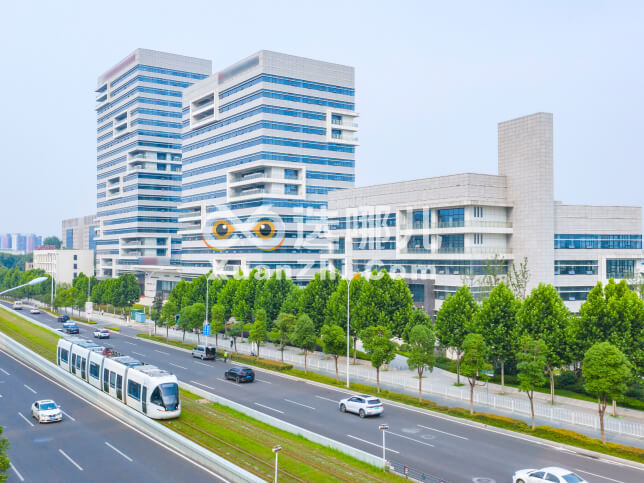
Government Overview
Located in the northeastern part of Chengdu, Qingbaijiang District covers an area of 379 square kilometers and has a population of over 700,000. It is home to the Chengdu International Railway Port and serves as the departure point for the Chengdu-Europe Railway Express, boasting multiple prestigious designations such as a national-level economic and technological development zone, a free trade zone, and a comprehensive bonded zone.
Qingbaijiang District steadfastly implements the development strategy of “building the city around the port, revitalizing it through industry, and enhancing its quality,” reshaping its economic geography and optimizing spatial layout to build an urban spatial development pattern characterized by “one port leading the way, two cores thriving together, and four zones working in concert.” By coordinating the integrated development of industry and urban areas and leveraging its three major industrial parks to drive the clustering of open industries, the district has achieved a transition from old to new growth drivers. The achievements of its transformation of the old industrial base were featured in the United Nations’ *Special Edition of the China Human Development Report*.
Qingbaijiang District is home to three major industrial parks. Among them, the Chengdu International Railway Port has established an international freight train network and a land-sea freight distribution system with Chengdu as the main hub, extending westward to Europe, northward to Mongolia and Russia, eastward to Japan and South Korea, and southward to ASEAN. This network comprises seven international rail routes and five international rail-sea intermodal corridors, connecting 68 cities overseas and 20 cities within China;The district has established a national multimodal transport customs supervision center and ports for grain, meat, and complete vehicles, while the Chengdu International Trade Industrial Park and the “Belt and Road” Import-Export Commodity Trading and Exhibition Center are under accelerated construction. Taking the establishment of the Sichuan China-Europe Railway Express Hub Alliance as a new starting point, the district is providing efficient and convenient services to facilitate the export of goods from Sichuan and expand overseas markets, with the goal of driving Sichuan’s total import-export trade volume to exceed $15 billion by 2024.The city has attracted 200 projects with a total investment exceeding 100 billion yuan, including those from SF Express and Xiamen C&D, and has attracted 41 companies ranked among the top 50 in supply chain management.The European Industrial City, with a planned area of 79 square kilometers, focuses on export processing, intelligent equipment manufacturing, and the digital economy as its leading industries. It is accelerating the development of an Eurasian export-oriented advanced manufacturing base. It has attracted 83 projects with a total investment of 94 billion yuan, including those by Konka Intelligent Manufacturing and Huading Guolian, and is accelerating the development of the Yacheng-Rongcheng-Europe Railway Port Smart Manufacturing Import-Export Base. The High-Performance Fiber Materials Industrial Park, with a planned area of 54 square kilometers, focuses on three future growth sectors: high-performance fibers and composite materials,new energy equipment, and green building materials. Leveraging two industrial ecosystems—new materials and carbon neutrality—it aims to build a nationally first-class innovation and development base for high-performance fibers and composite materials, as well as a domestically leading new energy equipment manufacturing base. It has attracted 93 projects with a total investment of 116.7 billion yuan, including Zhanlan Technology, and is accelerating the development of a nationally first-class advanced metal materials R&D and manufacturing base and a national pilot zone for carbon neutrality industrial development.Currently, the district has attracted 230 high-caliber enterprises, including 230 companies from the Fortune Global 500 and China’s Top 500 lists.
Qingbaijiang prioritizes reform and innovation, pioneering the nation’s first “single-document system” for multimodal transport. Its consolidated cargo consolidation and distribution model has been included among nationally replicable and promotable reform pilot experiences, yielding 108 reform and innovation achievements. The district established the Qingbaijiang Free Trade Zone Office of the State Administration of Foreign Exchange’s Sichuan Branch, pioneered a new model for financing freight costs on China-Europe freight trains, and facilitated cross-border RMB settlement.We have continued to deepen the “streamlining administration, delegating power, and improving services” reform, striving to build a model district for an international business environment while advancing institutional innovation and process reengineering. We innovatively implemented the “single-seal approval” system, ensuring that 100% of government service matters can be handled online and 98% are processed through a single service window, with a commitment-to-completion rate reaching 92%.The district pioneered the national integration of the “Three Reforms” into the market access and business operation system, as well as a “seamless declaration” model for business registration, significantly reducing the number of approval items and processing times for market access and business operations. We actively established platforms for matching supply and demand of green building materials and for bank-enterprise collaboration, promoting a steady increase in local supply chain coverage, coordinated development among upstream and downstream enterprises in the industrial chain, and a gradual reduction in enterprises’ actual financing costs. The district has received numerous honors, including the title of “National Demonstration Zone for International Business Environment Development.”