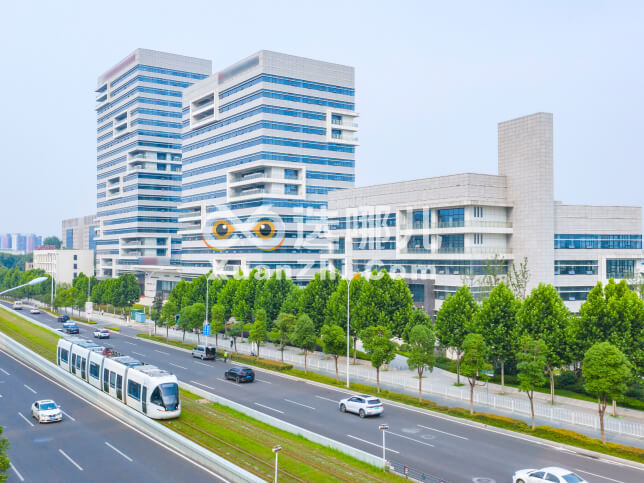
Government Overview
Located in central Anhui, Wuwei City lies along the Yangtze River and Lake Poyang, serving as a bridge between the east and the west. It currently administers 20 towns and one provincial-level economic development zone, with a total area of 2,022 square kilometers. The county was upgraded to city status in 2019.By the end of 2024, the city’s registered population stood at 1.166 million, with a permanent resident population of 834,000. For the year, the city achieved a regional gross domestic product (GDP) of 71 billion yuan, representing a 5.7% increase, while general public budget revenue grew by 5%.Industrial added value from enterprises above designated size, fixed-asset investment, and total retail sales of consumer goods increased by 10%, 11.4%, and 5.7%, respectively. Per capita disposable income for urban and rural residents rose by 5.1% and 6.4%, respectively. The city’s comprehensive economic strength has ranked among the top 10 in the province and the top 100 in Central China for many consecutive years.The city has been successively honored as a National Advanced County for Scientific and Technological Progress, a Model County for the Intellectual Property Strong County Project, a Model Base for New Industrialization, a National Model County for Safe Fisheries, and a Demonstration Zone for Healthy and Ecological Aquaculture.For six consecutive years, it has been selected as one of the “Top 100 Counties for National Scientific and Technological Innovation.” It has once again been named among the “Top 10 Counties in the Province for Comprehensive Manufacturing Development” and an “Outstanding County in the Province for Safe Community Construction.” It has been honored as an “Outstanding Unit in the Province for Optimizing the Business Environment,” a “Top 10 County in the Province for Agricultural Product Processing,” a “Top 10 County in the Province for Aquaculture,” and a “Leading County in the Province for Per-Mu Economic Output.” Additionally, it received provincial government incentives for its work in promoting rural industries and developing affordable housing.
Wuwei boasts a long history and a wealth of talent. The city’s name derives from the philosophy of “thinking of the peace of the world through inaction and governing without intervention.” Since its founding during the Sui Dynasty, it has a history spanning over 1,400 years. During the War of Resistance Against Japan and the Liberation War, it served as the central area of the Wanjiang Anti-Japanese Base Area and the departure point of the “First Boat Across the Yangtze.”Historically, the calligrapher and painter Mi Fu served as the military governor of Wuwei for three years. The county has produced distinguished figures such as Chen Ling, the founding patriarch of Taiwan; the “Father-Son Chancellors” Wang Zhi-dao and Wang Lin; and the philosopher Wu Tinghan. In modern times, it has given rise to the anti-Japanese national hero Dai Anlan,and the “Drum-beating Poet” Tian Jian. In contemporary times, the county has produced Ma Maojie, recipient of the “July 1st Medal” and “First-Class Meritorious Service in the Yangtze River Crossing,” as well as renowned composer Lü Qiming, alongside business elites such as Wang Chuanfu and Jiang Chun, who feature on the Hurun Rich List.
Wuwei enjoys a superior geographical location with distinct advantages. Situated along the “Yangtze River Axis” of the Wanjang Urban Belt Industrial Transfer Demonstration Zone, within the Yangtze River Delta urban cluster and the “Wuhu Core,” it lies at the intersection of the Nanjing Metropolitan Area, the Hefei Economic Circle, and the Ma-Wu-Tong Economic Circle. The Beijing-Fuzhou High-Speed Railway and the Shangqiu-Hefei-Hangzhou High-Speed Railway traverse the region,The Lu-Tong Railway, Wuhu-Tongling Expressway, North Yangtze River Expressway, and Wuhu Second Yangtze River Bridge Connector have been fully completed. National Highway 347, Provincial Highway 218, and the eastern extension of the Yuewu Expressway have been built and opened to traffic. The main section of the Tongjiang Avenue rapidization project has been opened to traffic, and a number of major transportation infrastructure projects, such as the Tong-Shang Expressway, are being accelerated. The site selection for the Wuwei General Aviation Airport has passed review, and the “One Ring, Four Radials” external transportation network has basically taken shape.The city’s first five-star standard hotel has officially opened. Chengdong Park and Daosun Park have been completed and opened to the public, while projects such as Jinta Park and the RT-Mart Commercial Center are accelerating construction. Preliminary work on the Mi Fu Cultural Park and the Cultural Arts Center is proceeding in an orderly manner, significantly enhancing the city’s supporting infrastructure.
Wuwei is rich in resources and boasts a healthy ecosystem. Surrounded by mountains to the northwest and crisscrossed by waterways to the southeast, the city features picturesque landscapes and a pleasant environment, earning it the traditional reputation as a “land of fish and rice.”Natural and cultural landmarks such as the Mi Gong Shrine, Boshan Cave, Golden Pagoda, San Gong Mountain, Wannian Terrace, Zhusi Lake, and the former site of the 7th Division Headquarters of the New Fourth Army are renowned far and wide. The county has successively been awarded the titles of Provincial Civilized City, Forest City, and Sanitary City, and has been selected as a Provincial Model County for Rural Revitalization, a Model County for Ecological Civilization Construction, and a Pioneer County for Agricultural Science and Technology Modernization.Wucheng Town, Gaogou Town, Nicha Town, and Shijian Town have been shortlisted for the 2024 National Top 1,000 Towns by Comprehensive Strength. Gaogou Town, Yaogou Town, and Hemao Town have been designated as “National Towns with Beautiful Environments” and “National-Level Ecological Towns,” respectively, while Hongmiao Town has been recognized as a Provincial Rural Revitalization Model Town.
Wuwei has achieved strong industrial agglomeration and robust development. Adhering unwaveringly to the strategy of building a city through industry, the city has accelerated the clustering and development of distinctive industries, forming a modern industrial system dominated by two traditional industries—wire and cable, and down and feather products—as well as two emerging industries—new energy vehicle components and green food. The wire and cable industry ranks second in comprehensive strength among the nation’s four major production bases and is the country’s sole special-purpose cable industrial base; it has been successfully selected as a national-level SME specialty industrial cluster.The new energy vehicle components industry achieved an output value of 27.5 billion yuan in 2024, with BYD Fudi Battery contributing 18.7 billion yuan of that total. The value added of the city’s 287 large-scale enterprises grew by 10%.Five cable enterprises—Guodian, Huayu, Huaneng, Hualing, and Xinyate—were named among the Top 100 Most Competitive Enterprises in China’s Wire and Cable Industry. BYD was once again selected for the provincial “Top 100” list in both private enterprise revenue and manufacturing, while Three Squirrels joined the provincial “Top 100” list in both private enterprise revenue and the service sector.
Looking ahead, we will anchor our efforts on the strategic goals of “focusing on high-quality development, surpassing 100 billion yuan in output value, and establishing a sub-provincial center.” We will strive to build distinctive industrial clusters, a pioneer zone for urban-rural integration, a leading zone for innovation and entrepreneurship, a zone for green development and transformation, and a people-oriented haven where work and life are harmonious and shared. We will accelerate the construction of Wuhu as a sub-provincial center, strive to take the lead in high-quality county-level development across the province, and continuously write new chapters in the Wuwei model of Chinese modernization.