Park Overview
I. Overview
The Urumqi Industrial Internet of Things Industrial Park actively supports the High-Tech Zone (Xin Shi Qu)’s leading industries, including the digital economy, biopharmaceuticals, and aviation-related industries. It integrates functions such as corporate headquarters, R&D, design, and pollution-free manufacturing, with a focus on attracting the “3+1” industries (next-generation information technology, modern services, biopharmaceuticals and healthcare, and headquarters economy) to establish a hub for Urumqi’s digital economy.
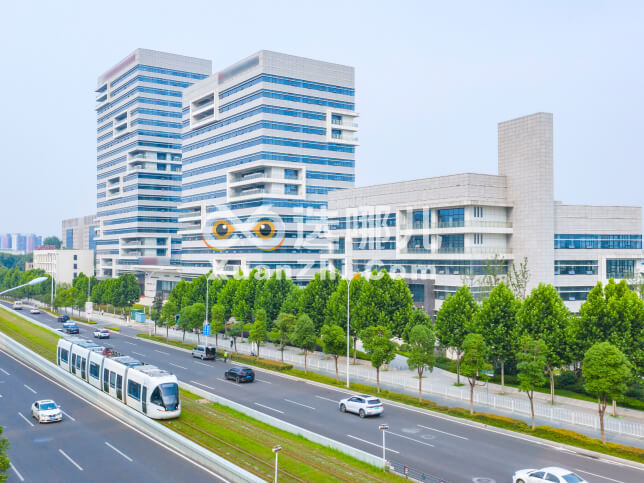
Located at the intersection of Changchun North Road and Lingang Street in the High-Tech Zone (Xin Shi Qu), the industrial park covers an area of 97 mu (approximately 6.47 hectares). With a total investment of 613 million yuan, it features a total floor area of 147,700 square meters (129,500 square meters available for lease), comprising three new-concept factory buildings and one supporting building. Construction began in July 2021, and the park is scheduled to commence operations in June 2024.
II. Architectural Design
The industrial park was designed by Zhejiang Southern Design Institute, a company within the Alibaba ecosystem. The design emphasizes the integration of “production, living, and ecology” and the concept of “large courtyards with small enclosures” to create a modern technology park.The industrial park comprises Factory Buildings 1, 2, and 3, as well as Support Building 4. Specifically: Building 1 is a multi-story factory building with a floor area of 37,100 square meters; Building 2 consists of both multi-story and high-rise sections with a floor area of 38,600 square meters; and Building 3 consists of both multi-story and high-rise sections with a floor area of 34,700 square meters.The ceiling height is 5.9 meters on the first floor, 4.5 meters on the second and third floors, and 4.2 meters on the fourth floor and above. The floor load capacity is 1.5 tons per square meter on the first floor and 400 kilograms per square meter on the second floor and above. Building 4 serves as the park’s non-production support facility, with a gross floor area of 19,200 square meters, providing office spaces, a cafeteria, shared meeting rooms, guest rooms, and other supporting services.
III. Park Positioning
Guided by technological innovation and driven by the mission to boost industrial development, the park is positioned to “facilitate inter-park collaboration, create a radiating ecosystem, and lead the city.” By constructing smart factories, a big data center, a training center, and a technology exhibition center—while aggregating resources for innovation, entrepreneurship, and makers—the park aims to build a new type of integrated complex that uses data as its foundation and seamlessly integrates industrial and urban lifestyle services. Leveraging digital management methods, the park will steadily improve its business environment to attract more enterprises, thereby forming a cluster of strategic emerging industries.
Focusing on the “Health Silk Road” international traditional Chinese medicine (TCM) and wellness industry, we will collaborate with the digital technology platforms of the Shanghai Cooperation Organization (SCO) member states and the “Belt and Road” AI+TCM Industry Alliance. Partnering with medical institutions such as Xinjiang Medical University and the Autonomous Region Hospital of Traditional Chinese Medicine, and guided by the scientific leadership of multiple academicians, we will build an AI-IoT platform based on the “three-chain integration” (digital technology chain, TCM industrial chain, and cross-border service chain). with a focus on projects such as community health service centers and an electronic trading center for bulk traditional Chinese medicinal materials. This initiative aims to establish a new digital healthcare hub connecting China and Central Asian nations, a new paradigm for the silver economy, and a new integrated "industry-academia-research-innovation" hub for AI, traditional Chinese medicine, and the silver economy.