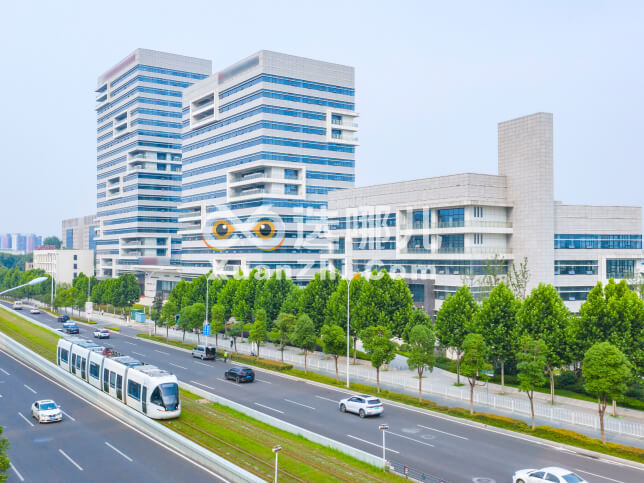
Park Overview
Introduction to Yinchuan High-Tech Zone
Established in 2003, Yinchuan High-Tech Zone was approved by the State Council as a national-level high-tech zone in 2010. As a key industrial base in Yinchuan, it has been honored with numerous titles, including one of the nation’s first Green Industry Demonstration Bases, National Green Park, National Foreign Trade Transformation and Upgrading Base, National Urban Mineral Resources Demonstration Base, China’s International Capital of Premium Cashmere, All-China Federation of Industry and Commerce Private Enterprise Science and Technology Innovation Base, and Technology Transfer Base for the China Innovation and Entrepreneurship Achievement Fair.
Geographical Advantages: Located approximately 48 kilometers from Yinchuan City and 25 kilometers from Hedong International Airport, the zone offers over 50 daily flights, providing convenient access to major cities such as Beijing, Shanghai, Guangzhou, and Xi’an. The urban built-up area features a primary road network of “eight horizontal and eighteen vertical” arteries, with National Highways 109 and 110, the Qingdao-Yinchuan Expressway, the Fuyin Expressway, and the Beijing-Lhasa Expressway passing through the zone.The Tai-Zhong-Yin and Bao-Lan railways run north-south, while the Bao-Zhong Railway connects the Beijing-Baotou and Longhai trunk lines. The Yinchuan-Xi’an and Yinchuan-Lanzhou high-speed railways have achieved full connectivity within Ningxia, and three “two horizontal, one vertical” lines to Haikou, Qingdao, and Hohhot have been included in national planning.The region contains 3,500 square kilometers of coal-bearing areas, with proven reserves of 27.3 billion tons and prospective reserves of 202.6 billion tons, making it one of the country’s 13 billion-ton-class coal production bases.
Planned Area: The planned area covers 35.44 square kilometers, with 26.71 square kilometers designated for construction. This includes 1,190.72 mu of underutilized land. The park is divided into three sub-zones: the Yinchuan High-Tech Zone Main Area, the Yuehai Bay Central Business District, and the Yinchuan Zhongguancun Innovation and Entrepreneurship Science and Technology Park.
Infrastructure: Over 52.537 kilometers of roads have been constructed within the park, ensuring full connectivity to all industrial zones;Water supply and drainage networks, as well as gas pipelines, have been laid along the park’s roads to meet the park’s water supply, drainage, and gas needs; multiple communication base stations have been constructed within the park, achieving full coverage of China Mobile, China Telecom, and China Unicom networks in the area. The Yinchuan High-Tech Zone Approval Service Hall has been established, which, through “Internet Plus Government Services,” centrally handles various matters such as approval, registration, filing, and land-related procedures, effectively ensuring basic public services and realizing the principle of “handling enterprise matters within the park and park matters within the park.”
Enterprises in the Park: There are currently 778 registered enterprises, including 30 industrial enterprises above designated size, 41 technology-based small and medium-sized enterprises, and 26 national high-tech enterprises.
Innovation Capacity: The park boasts 58 national and autonomous region-level R&D innovation platforms, with an R&D intensity of 4.64%. It ranks 129th and 102nd, respectively, among the 169 national-level high-tech zones in terms of the number of invention patents per 10,000 people and the number of national incubators (co-working spaces)(2022 data). Currently, the park is home to expert R&D teams such as the Xinao Cashmere Xi’an University of Engineering Industry-Academia-Research Team and the “Xinao Cashmere Textile Dyeing Technology” Research Team; it has established 4 autonomous region-level engineering technology research centers, 6 autonomous region-level enterprise technology centers, and 42 autonomous region-level technology innovation centers;two autonomous region-level “Specialized, Refined, Unique, and Innovative” (SRUI) SMEs, and 10 SRUI “Little Giant” enterprises.
Leading Industries: The park has established a “3+X” industrial system. Specifically: three leading industries—modern textiles, circular economy, and green food; and emerging sectors such as new energy, new materials, and fine chemicals (hydrogen chemicals). The park has essentially formed an industrial ecosystem and cluster development pattern characterized by collaborative support and integrated development among large, medium, small, and micro enterprises.
Development Status: In 2025, the total industrial output value of enterprises above designated size reached 8.682 billion yuan, a year-on-year increase of 6.1%; industrial value-added of enterprises above designated size reached 1.771 billion yuan, a year-on-year increase of 5.3%; cumulative fixed-asset investment reached 8.078 billion yuan, a year-on-year increase of 9.4%; and actual in place funds from investment promotion reached 3.246 billion yuan, a year-on-year increase of approximately 2.2%.In the first three quarters of 2025, the zone ranked second among Yinchuan’s eight industrial parks in the economic development index assessment; in the fourth quarter, it ranked first, indicating that the overall economic operation remained stable with steady progress.
Industrial Situation in Yinchuan High-Tech Zone
(1) Photovoltaic Industry
As a region with a competitive advantage in the photovoltaic industry, Ningxia has seen its installed photovoltaic capacity increase year after year, resulting in a massive market for decommissioned photovoltaic modules. However, recycling and reuse have not yet reached a significant scale.With the national emphasis on photovoltaic module recycling and the issuance of the "Implementation Opinions on Promoting the Comprehensive Utilization of Solid Waste" by the General Office of the People’s Government of the Ningxia Hui Autonomous Region—which encourages enterprises to engage in the precise dismantling and high-level recycling of new types of solid waste such as decommissioned wind power and photovoltaic equipment—this will create significant market opportunities for Ningxia’s photovoltaic module recycling industry.As one of the national hub nodes in China’s integrated computing power network, Ningxia has seen rapid development in its computing power industry, with server production capacity continuously increasing. According to Yinchuan City’s “Implementation Plan for High-Quality Development of the Computing Power Industry (2025–2027),” server manufacturing capacity is projected to reach 400,000 units by 2027, which will further drive the development of the computing power server dismantling industry.At the same time, Yinchuan City has introduced relevant policies to support the development of enterprises engaged in the dismantling and comprehensive utilization of computing servers. Enterprises with annual sales of 20 million yuan or more will receive a reward equivalent to 1% of their sales, with a maximum annual reward of 10 million yuan per enterprise.
Since 2009, the photovoltaic giant LONGi Green Energy has successively established Yinchuan LONGi Silicon Materials Co., Ltd., Yinchuan LONGi Liyue Photovoltaic Technology Co., Ltd., Yinchuan LONGi Photovoltaic Technology Co., Ltd., and Ningxia LONGi Optoelectronics Technology Co., Ltd. in Yinchuan, forming a relatively complete photovoltaic industrial chain.In 2025, the park attracted the solar integrated base and large-scale power plant project of Italy’s Fotovola (Yinchuan) Technology Co., Ltd. The project has a planned total investment of 6.5 billion yuan. Phase I involves an investment of 2 billion yuan to construct a 5 GW solar module factory and a 500 MW perovskite pilot workshop; Phase II plans an investment of 4.5 billion yuan to build an 8 GW HJT solar cell factory, further strengthening the new energy industrial chain and driving the extension of photovoltaic manufacturing from modules to high-value-added segments.
(2) Renewable Resources Industry
The Ningxia Renewable Resources Industrial Park is located in Lingwu City, Yinchuan. It serves as a regional resource recovery and recycling base for the 500-kilometer surrounding area encompassing Ningxia, Inner Mongolia, Shaanxi, Gansu, and Qinghai—including the “E-Yu-Yin” energy “Golden Triangle,” the “Hu-Bao-Yin” economic zone, and the cities along the Yellow River.The park covers a total area of 10,000 mu and is structured around “One Zone and Five Parks” with “Five Major Industries.” “One Zone” refers to the Recycled Resources Trading Zone, while “Five Parks” include the Non-ferrous Metal Recycling Park, the Electronic Waste and Metal Profile Processing Park, the Recycled Resources Building Materials Park, the Non-metallic Resources Recycling and Processing Park, and the Used Car Trading and End-of-Life Vehicle Dismantling Park.The “five major industries” include deep processing of non-ferrous metals such as recycled aluminum and copper; electrical equipment manufacturing; processing of new building materials; electronic waste treatment and processing; and the dismantling of end-of-life vehicles and machinery, as well as used car trading.Long-term Development Goals for the Renewable Resources Industrial Park: Focusing on the networking of recycling systems, rationalization of industrial chains, scaling up of resource utilization, advancement of technology and equipment, sharing of infrastructure, centralization of environmental treatment, and standardization of operations and management, we are fully committed to transforming the park into the largest renewable resources circular economy demonstration zone in Northwest China—one that relies on Ningdong, is rooted in Ningxia, and radiates to surrounding areas.
The park currently hosts over 100 enterprises, including the state-owned China Resources (Ningxia) Co., Ltd. and the listed company Kunming Engineering Hengda (Ningxia) New Energy Co., Ltd., which are engaged in the recycling and dismantling of end-of-life vehicles, waste electrical and electronic equipment, scrap metal, and batteries.In the future, the park will focus on the collection, processing, and dismantling of waste materials, as well as the deep processing and utilization of renewable resources. It will enhance supporting services such as R&D, warehousing, logistics, and business operations, with a strategic emphasis on the processing and utilization of recycled non-ferrous metals, the dismantling of electronic waste, and the dismantling of end-of-life vehicles. The goal is to establish a complete industrial chain for the recycling and utilization of renewable resources, thereby forming a circular economy model characterized by the cycle of “resources—products—waste—renewable resources.”
(3) Cashmere Textile Industry
The Eco-Textile Park covers an area of 5,000 mu with a total investment of 20 billion yuan. It has established a diversified industrial structure centered on the deep processing of cashmere, wool yarn, linen fabrics, and high-end apparel. Relying on the autonomous region’s “chain leader” enterprise, Xin’ao Cashmere, the park strengthens upstream-downstream coordination to achieve stable and increased production.The park is home to well-known enterprises such as Ningxia Xin’ao Cashmere Co., Ltd., Ningxia Xinzhongrong Cashmere Apparel Co., Ltd., Ningxia Guobin Yaqi Textile Co., Ltd., and Ningxia Boshiqirongchang Cashmere Industry Group Co., Ltd., and has become the largest processing and trading base for high-end cashmere products in China and even the world.
(4) Green Food Industry
The region will prioritize the development of niche sectors such as dairy production, grain and oil processing, beef and mutton processing, and feed processing. Under the leadership of leading enterprises—including Mengniu Dairy and Feihe Dairy, which are recognized as “Lighthouse Factories” globally and among the first batch of national “Excellence-Level Smart Factories”—the region’s production capacity advantages will be rapidly realized.We will accelerate the implementation of a series of green electricity-to-hydrogen demonstration projects to establish a “Three Greens” industrial development model—integrating “green electricity, green hydrogen, and green chemicals.” This will achieve the deep integration of hydrogen energy’s full-chain supply and utilization—covering production, storage, transmission, and consumption—and promote coordinated development across the entire industrial chain, with a concerted effort to build the core zone of China’s Green Hydrogen Valley.
(5) New Energy (Hydrogen Chemical) Industry
Deeply advance the revolution in energy production and consumption. Leveraging the “wind, solar,thermal power, storage, and hydrogen” resources in the areas surrounding Yinchuan High-Tech Zone. We will prioritize the implementation of new energy projects such as next-generation energy storage batteries, solar photovoltaic modules, and integrated green hydrogen production, storage, transmission, and utilization systems. We will accelerate the development of new energy equipment and advanced materials industries related to wind power, solar energy, next-generation energy storage, and hydrogen energy, extending into downstream industrial chains and high-end manufacturing. We will promote the substitution of green hydrogen within the coal-based energy system and concentrate efforts on building the core area of China’s Green Hydrogen Valley.