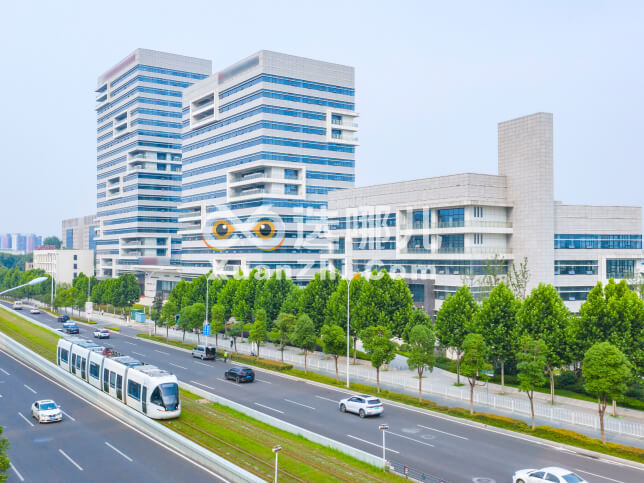
Park Overview
The Langfang Emerging Industries Demonstration Zone in Hebei Province was established in 2010 with the approval of the provincial government. It is the first provincial-level demonstration zone in the province, promoted by the provincial Party committee and provincial government, primarily focused on attracting strategic emerging industries. It serves as the optimal region for receiving the transfer of high-end industries from Beijing and Tianjin, and construction began in September of the same year. In November 2014, the demonstration zone was further approved by the provincial government as the Langfang High-Tech Industrial Development Zone, marking a significant upgrade of its industrial platform.The park has a total planned area of 73 square kilometers, with an initial development zone of 10 square kilometers. Its leading industrial sectors include energy conservation and environmental protection, electronic information, high-end equipment manufacturing, new energy, new materials, and emerging service industries. To date, with the care and support of provincial, municipal, and district leaders as well as departments at all levels, the park has achieved a strong start in its initial phase, completing phased results in development and construction tasks such as establishing the framework, laying the foundation, creating the environment, and clustering industries.
The park enjoys unique geographical advantages. Located 20 kilometers south of downtown Langfang, it lies at the heart of the Beijing-Tianjin-Hebei coordinated development zone, with Beijing and Tianjin city centers each 60 kilometers away. It is surrounded by four expressways—the Beijing-Taiwan, Langfang-Cangzhou, Beijing-Shanghai, and Tianjin-Baoding—as well as three high-standard railway lines: the Tianjin-Baoding, Tianjin-Baoding Intercity, and Beijing-Shanghai High-Speed Rail.Notably, the Beijing-Taiwan Expressway features two exits in the northern part of the park, reducing travel time between the High-Tech Zone and Beijing and Tianjin to under 40 minutes—a golden travel window. The High-Tech Zone is 60 kilometers from both Beijing Capital International Airport and Tianjin Binhai International Airport, and just 40 kilometers from the under-construction Beijing Daxing International Airport. Within a 150-kilometer radius, it boasts four seaports—Tianjin, Tangshan, Cangzhou, and Qinhuangdao—forming a well-developed three-dimensional transportation network encompassing sea, land, and air routes.
Planning and design lead the way.We adhere to the principle of "planning-led development." Guided by the concept of "integrated industry and city" and the design principles of "smart, low-carbon, and water-efficient," we engaged the original design team from Suzhou Industrial Park—Singapore-based Bangcheng Planning Consultants—to complete the 73-square-kilometer master plan for the park, the 10-square-kilometer control detailed plan for the initial development zone, and the 2-square-kilometer urban special plan, all to high standards. Additionally, they compiled over 30 specialized plans, including water systems, environmental impact assessments, and power and telecommunications infrastructure, thereby strengthening the role of planning as a guiding force.In the Park’s land use allocation system, commercial and residential land accounts for 27.7%, industrial land for 35.3%, public management and service facilities for 8.7%, green space for 13%, and comprehensive transportation infrastructure for 14.5%. This fully embodies the urban development concepts of “integration of industry and city” and “people-oriented” development.
Infrastructure support is well-developed. Cumulative infrastructure investment has reached 3 billion yuan. The two main arterial roads—Longji and Fengxiang—as well as the dedicated corridor connecting the city center to the High-Tech Zone—Langfang’s third major southern corridor—have been fully completed and opened to traffic, with the total length of the road network exceeding 60 kilometers.Supporting facilities such as heating stations, water treatment plants, sewage treatment plants, stormwater and wastewater pumping stations, substations, gas utilities, telecommunications infrastructure, and enterprise service centers have been successively completed and put into operation. The park’s supporting functions now cover the entire 10-square-kilometer initial development area, with some functions extending to 30 square kilometers, providing the capacity to attract and support large-scale projects.Furthermore, to address gaps in the park’s industrial and urban functions, an investment of 800 million yuan has been allocated this year to launch the construction of a mixed-use commercial and residential complex integrating talent-oriented communities, convenience service centers, schools, hospitals, and experience centers. Additionally, projects include the ecological restoration of Longhu Lake and its water systems, the construction of nine roads—including the southern extensions of Longxi, Fenghe, and Fengyang Roads—as well as sewage lift stations and other living service and commercial support facilities, comprehensively enhancing the region’s overall functional capabilities.
The leading industries are beginning to take shape. In line with the development goal of building a 100-billion-yuan-level park for coordinated development in the Beijing-Tianjin-Hebei region, the High-Tech Zone has proactively aligned with Beijing and Tianjin to accelerate industrial clustering. Currently, the 440-million-dollar Quan’en High-Tech Pipe Project has achieved mass production, with a cumulative output value of 630 million yuan. As the market gradually expands, this project has laid a solid foundation for the goal of establishing the world’s largest single-site production facility for plastic pipes.Major projects, including the 5-billion-yuan New Materials (Carbon Fiber) R&D and Manufacturing Base, the 3.1-billion-yuan Kangde Carbon Fiber Vehicle Body Project, the 220-million-dollar Taiwanese Contact Lens Project, the Taiwanese Quancheng Automation Equipment Project, the German Mahle Automotive Exhaust Emission Testing Equipment Project, 3D printing and additive manufacturing, and the Andy Xiaowen New Energy-Saving and Environmentally Friendly Materials Project, are all under construction and will be completed and put into operation one after another by the end of the year.In addition, key projects with a total investment of 5 billion yuan—including high-tech petroleum equipment, the European Energy Efficiency and Environmental Protection Industrial Park, the Comprehensive Bonded Zone and Technology Transfer Incubation Base, the Comprehensive Financial Logistics Industrial Park, a facility with an annual output of 14,400 tons of new wood-plastic composite materials, a facility with an annual output of 20 million high-precision structural components, and the Northern Jiake Printing and Packaging Production Base—have recently commenced construction.Projects such as the China-Canada Emerging Industries City—a Phase I investment of $1.5 billion aimed at establishing a national-level platform for collaboration between China and Canada in high-tech, satellite remote sensing, environmental protection, and life sciences—the China (Beijing-Tianjin-Hebei) Agricultural and Sideline Products Electronic Trading and Settlement Center, and the Zhongshi Food Safety Purification Equipment project were officially signed and established during the May 18th period, injecting new vitality into the park’s development.