Park Overview
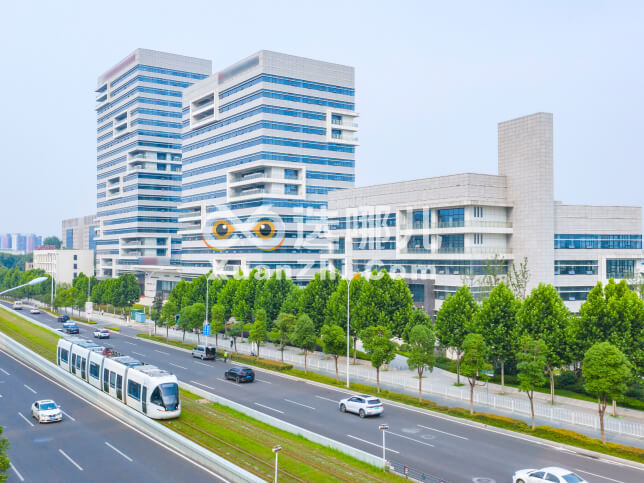
The Bengbu Economic Development Zone was established in August 2001 with the approval of the provincial government. Ranked among the top 20 provincial-level development zones in Anhui, it is located east of Bengbu’s main urban area, bordered by the Huai River to the north and extending eastward to Fengyang.After 20 years of development, having gone through the “Square Era,” “Lakeside Era,” and “High-Speed Rail Era,” the zone is now fully transitioning into the “Port Era.” The Bengbu Economic Development Zone currently covers an area of 53 square kilometers, comprising one town—Changhuaiwei—and 14 administrative villages (residential communities), with a permanent population of 30,000. It is home to 11 primary and secondary schools and 4 kindergartens.
The zone boasts significant locational advantages. Its transportation network—comprising rail, road, water, and air routes—is well-connected. The Beijing-Shanghai Railway, Beijing-Shanghai High-Speed Railway, and Huai-Su-Beng Intercity High-Speed Railway traverse the entire area. It takes 10 minutes to reach Bengbu South High-Speed Railway Station, 1 hour to reach Nanjing or Hefei, 2 hours to reach Shanghai, and 3 hours to reach Beijing. The Bengbu-Wuhu Expressway runs through the city, while the Nanjing-Luohe and Hefei-Xuzhou Expressways run alongside it.Upon completion, the Bengbu Zhongcheng International Port—a major port on the Huai River—will provide direct access to the Yangtze River and the sea. It is a one-hour drive from the Bengbu Airport (currently under construction) and a one-and-a-half-hour drive from Hefei Xinqiao Airport.
The city boasts a robust industrial foundation. Leading enterprises such as China North Industries Group, BYD Group, Anhui Construction Engineering Group, Aofu Environmental Technology, Ximagnetics Technology, and Xindong Lianke have successively established operations here. Industrial clusters including China (Bengbu) Sensor Valley, the University Science and Technology Park, the Carlson Industrial Park, and the Lingang Industrial Park are fully functional.Parks such as the Ningbo-Bengbu Microelectronics Industrial Park, Ningbo-Bengbu New Materials Industrial Park, Medical Device Industrial Park, Wanchuang (Northern Anhui) Intelligent Supply Chain Logistics Park, and Bengbu Intelligent Manufacturing Industrial Park are under accelerated development, having preliminarily formed an industrial development system dominated by electronic information, high-end equipment manufacturing, new energy and new materials, medical devices, and commercial logistics.
Concentration of innovation resources. The area is home to numerous science and technology innovation bases, such as the University Science and Technology Park and the Carlson Industrial Park. Research platforms including the National Manufacturing Innovation Center for Glass New Materials, the Anhui Provincial MEMS Core Device Industry Innovation Center, the CAS-Bengbu Technology Transfer Center, the National-Local Joint Laboratory for MEMS, the MEMS Postdoctoral Research Station, and the Xiangyuan National Technology Transfer Demonstration Base are concentrated here, providing technical support for industrial innovation and development.
Excellent business environment. The “Four Deliveries and One Service” initiative and the “Industry-Park” one-on-one assistance mechanism are well-established, providing enterprises with full-process support services. The district’s “Internet Plus Government Services” system is mature, with comprehensive “end-to-end online processing” capabilities for government service matters and 100% coverage of the 24/7 government service map.
Abundant scientific and educational resources. The area is adjacent to five institutions of higher education—Anhui University of Finance and Economics, Bengbu Medical College, Bengbu University, Anhui Vocational College of Electronic Information, and Anhui University of Science and Technology—ensuring a plentiful supply of talent. Compulsory education resources are of high quality; the New City Experimental School ranks among the top three in the city, and its Lingang Branch—equipped with advanced information technology and smart facilities—is set to open soon.
Deep cultural heritage. The town of Changhuaiwei under its jurisdiction is a millennium-old town named by the Ming Dynasty’s founding emperor, Zhu Yuanzhang. It served as a major commercial and military stronghold during the Ming Dynasty, standing alongside Tianjinwei and Weihaiwei as the “Three Great Garrisons” of the nation. The area boasts numerous historical sites and anecdotes, including Yingjia Bridge, the Ancient Four-Eyed Well, the Peng Family Mansion, and the Tombs of the Ten Princes and Four Consorts.The “Wei Diao Huagu Opera” originated here. Together with Shuangtiao Drum and Huagu Lantern, these three forms are collectively known as the “Three Flowers of Fengyang.” It is the only opera genre from Anhui Province to be included in the *Encyclopedia of Chinese Opera and Repertoires*.