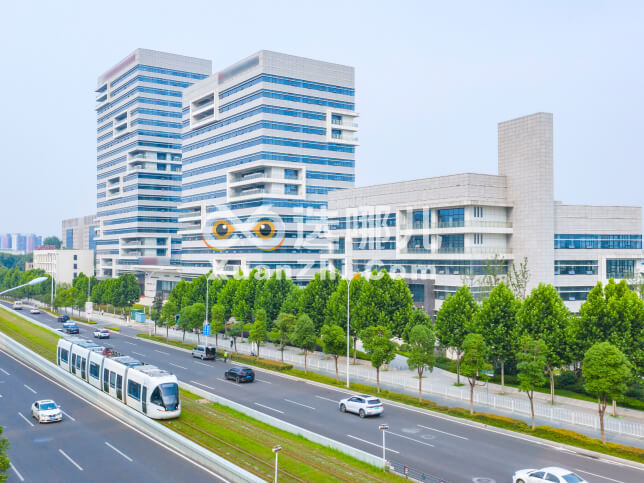
Park Overview
Established on April 21, 2015, it is the largest zone within the Guangdong Pilot Free Trade Zone, covering a total area of 60 square kilometers. It comprises seven sub-zones: the Seaport, Mingzhu Bay Start-up Area, Nansha Hub, Qingcheng Hub, Nansha Bay,Jiaomen River Central Area, and Wanqingsha Bonded Port Manufacturing Zone; it serves as a vital platform for comprehensive cooperation among Guangdong, Hong Kong, and Macao, as well as a key window for opening up to the outside world. To date, over 100,000 enterprises have been registered there, including more than 3,100 foreign-invested enterprises, and a total of 45 and 136 innovative achievements have been replicated and promoted nationwide and province-wide, respectively.Located in Nansha District, it is Guangdong Province’s only National New Area and a demonstration zone for comprehensive cooperation among Guangdong, Hong Kong, and Macao—a major strategic platform rooted in the Greater Bay Area, collaborating with Hong Kong and Macao, and facing the world.
Key Industries:
Each of the seven zones has its own key industries, collectively covering: shipping and logistics, bonded warehousing, international transshipment, international trade, commodity trading, automotive logistics, headquarters economy, financial services, commercial services, information technology, financial back-office services, technology transfer, professional services, education and training, healthcare, artificial intelligence, technological innovation, cultural and creative industries, service outsourcing,cruise and yacht economy, business services, new foreign trade models, processing and manufacturing, R&D incubation, data services, e-commerce, testing and certification services, semiconductors, and intelligent connected vehicles; the zone will focus on building the “Chip-Morning-Sea” specialty industrial cluster, establishing a “2+5+2” advanced manufacturing system, and solidifying the compound semiconductor industrial cluster.
Location and Transportation:
Located at the geographical center of the Guangdong-Hong Kong-Macao Greater Bay Area, at the southernmost tip of Guangzhou, on the west bank of the Humen Channel of the Pearl River, and at the confluence of the West River, North River, and East River;To the east, it faces Dongguan City across the river; to the west, it borders Zhongshan City and Shunde District of Foshan City; to the north, it connects with Panyu District of Guangzhou; and to the south, it borders Lingdingyang, the estuary of the Pearl River. It is 38 nautical miles from Hong Kong and 41 nautical miles from Macao. It serves as the passageway from the Pearl River Basin to the ocean, a key hub connecting the Pearl River Estuary urban cluster with Hong Kong and Macao, and Guangzhou’s sole maritime gateway.The transportation network is multi-dimensional, providing rapid access to the five international airports in the Greater Bay Area. It connects to the world via the Nansha Port Area of Guangzhou Port (the main port area of Guangzhou Port, the sixth-largest port globally). Advancing the construction of the “Greater Bay Area Half-Hour Transportation Circle,” it offers diverse transportation modes including airplanes, cruise ships, high-speed rail, metro, buses, and autonomous vehicles. With the full opening of the Qingcheng High-Speed Rail Station, travel is convenient and efficient.
Industrial Layout & Ecosystem:
Industrial Layout:
Seaport Zone (15 square kilometers): An International Shipping Development Cooperation Zone focusing on shipping logistics, bonded warehousing, international transshipment, international trade, bulk commodity trading, automotive logistics, and other shipping-related services;
Mingzhu Bay Start-up Zone (9 square kilometers): A Financial and Business Development Pilot Zone focusing on headquarters economy, financial services, and commercial services to promote financial services cooperation among Guangdong, Hong Kong, and Macao;
Nansha Hub Zone (10 square kilometers): Guangdong-Hong Kong-Macao Integrated Development Pilot Zone, focusing on information technology, financial back-office services, technology commercialization, and professional services;
Qingsheng Hub Zone (8 square kilometers): International Education and Healthcare Cooperation Pilot Zone, focusing on education and training, healthcare, and emerging industries such as artificial intelligence;
Nansha Bay Block (5 square kilometers): International Science and Technology Innovation Cooperation Zone, focusing on science and technology innovation, cultural creativity, service outsourcing, and the cruise and yacht economy;
Jiaomen River Central Zone (3 square kilometers): Comprehensive Service Zone for Overseas Investment, focusing on business services, fostering new forms of foreign trade, and attracting headquarters of small and medium-sized enterprises;
Wanqingsha Bonded Port Processing and Manufacturing Zone (10 square kilometers): Service Zone for the Transformation and Upgrading of International Processing Trade, focusing on processing and manufacturing, R&D incubation, data services, e-commerce, and testing and certification services, while promoting the development of industries such as semiconductors and intelligent connected vehicles.
Industrial Ecosystem:
Innovation Platform Support: Boasting high-level platforms such as the Hong Kong University of Science and Technology (Guangzhou), the Guangdong-Hong Kong Smart Valley, and the First Affiliated Hospital of Sun Yat-sen University (Nansha), the area has gathered four new-type R&D institutions. It features industrial parks such as the Wanqingsha Integrated Circuit Industrial Park and the Dagang Guangzhou-Hong Kong Smart Manufacturing Base, building a “three-full” innovation ecosystem;Industrial Chain Synergy: A comprehensive ecosystem has been formed covering the entire industrial chain of wide-bandgap semiconductors—including design, manufacturing, packaging and testing, and materials. This fosters a cross-regional synergy model of “Shenzhen R&D – Nansha Manufacturing,” with complementary industries across different zones creating a diversified and synergistic development system;Talent Aggregation Effect: Between 2010 and 2020, the youth population grew by 169,000 people at a rate of 147%, resulting in a younger demographic. A comprehensive talent service system has been established, including talent service stations and high-quality “talent communities”;Financial Service Support: The permanent venue for the International Finance Forum (IFF) has been established here. We are exploring pilot programs for the convertibility of the RMB under the capital account and developing sectors such as financial services and fintech to provide financial support for industrial development; Policy Support and Business Environment: We are deepening reforms of the administrative approval system and introducing multiple government service reforms to achieve “processing upon receipt of application” and “cross-regional processing.” We have established a one-stop government service center and the “Qi’an·Tunan” Office for Optimizing the Rule-of-Law-Based Business Environment;Integrated Industry-City Development: Explore the construction of an “organic city,” create a “15-minute living circle,” develop ecological landscapes and urban green spaces, and advance initiatives to connect mountains and seas with the city, integrate parks into the urban fabric, and fill the city with greenery, thereby establishing the “Nansha Model” for a green and beautiful Guangzhou.
Industrial / Development Zones:
Total area of 60 square kilometers, comprising 7 functional zones; the Qingcheng Hub Zone is advancing projects such as the Hong Kong University of Science and Technology (HKUST) Innovation District and Phase II of HKUST (Guangzhou); the Wanqingsha Zone houses over 30 industrial projects, including semiconductor and new energy enterprises such as Lianjing Intelligent, Xinyue Energy, Xinjuneng, and Rongjie;The Nansha Hub Zone is developing projects such as the Nansha Industry-City Innovation Valley and the Guangzhou Industrial Investment Greater Bay Area Digital Economy and Life Sciences Industrial Park, while simultaneously advancing supporting facilities for the Nansha Station; the Nansha Port Area has surpassed 20 million TEUs, ranking among the top ten globally as a single port area; in 2024, the output value of large-scale enterprises in the semiconductor and integrated circuit sectors grew by 33.8%.
Support & Services:
Government Services: 1,679 government service items available for immediate processing upon request; “cross-regional processing” linked with government services in 50 regions across 15 provinces; establishment of a one-stop government service center (including policy consultation and project applications); on-site services provided by stationed prosecutors; and the launch of 53 government service reforms;Lifestyle Amenities: The “iPARK Honghui Fang” themed district is being developed in the Qingcheng Hub area; amenities such as “shared dining halls,” the park library, and parcel stations are being enhanced to build a “15-minute living circle”;Education and Healthcare: 12 new schools (campuses) and public kindergartens (campuses) have been added, creating 8,220 new school places. Institutions such as the Hong Kong University of Science and Technology (Guangzhou) and the Guangzhou Nanhua Industry and Trade Advanced Technical School (Nansha Campus) have been established. Seven Grade A tertiary hospitals, including the First Affiliated Hospital of Sun Yat-sen University (Nansha), have been deployed, and the construction of six new or expanded district-level hospitals is accelerating;Commercial Ecosystem: Commercial complexes such as Nansha Xinghe COCO Park, Nansha Wanda Plaza, and Nansha Huanyu City have opened successively, enriching the night economy;Ecological Infrastructure: Projects such as the Nansha Wetland and Dashan’e Forest Park were developed; 331.27 hectares of forest were upgraded and reforested; 90.53 hectares of urban green spaces and 81.07 hectares of rural greening and beautification were completed; the Nansha Wetland was designated a provincial-level important wetland, and the Tantou Mangrove Forest was designated a municipal-level important wetland.